

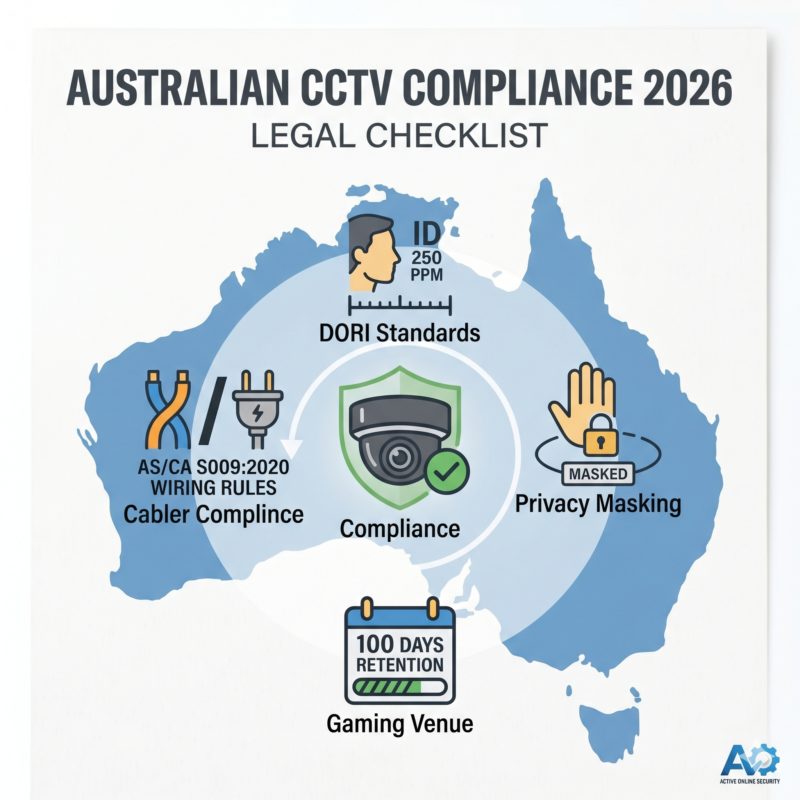
Before you drill a single hole, ensure your system meets these 5 critical Australian standards. Failing to do so can result in hefty fines, the suspension of your trading license, or footage being ruled inadmissible in court.
1. Mandatory Retention: The “30 to 100 Day” Variable
For licensed premises, retention is a legal mandate, not a suggestion.
The Minimum: Standard Liquor Licensing (NSW L&G, QLD OLGR, VGCCC) generally requires a minimum of 28–30 days.
Gaming & High-Risk: If your venue has Gaming Machines (Pokies), a TAB, or is in a “Prescribed Precinct,” your specific license conditions may mandate 90 to 100 days of continuous recording.
The “Audit” Risk: Inspectors frequently check that systems are actually recording for the full required period. If your NVR overwrites at day 27 when your license says 30, you are in breach.
Calculation: Because variables like Resolution, FPS, and Scene Activity change everything, do not guess your storage. Use our [Professional Storage Calculator] to ensure you meet your specific license requirements.
2. Mandatory Wiring Rules (AS/CA S009:2020)
All fixed CCTV cabling in Australia must comply with the “Wiring Rules” (AS/CA S009:2020) to ensure building safety and network integrity.
Separation of Services: Data cables (Cat6) must maintain specific physical separation from electrical power cables (240V) to prevent induction, interference, and fire risks.
The Law: Any cabling hidden in walls or ceilings is considered “fixed wiring.” Under Australian law, this must be installed by a person holding a current Open Cabler Registration. DIY “plug-and-play” is only legal for “patch” leads that are not fixed inside the building structure.
3. Audio Recording (The “Surveillance Devices” Act)
Recording audio is far more legally sensitive in Australia than video.
The Rule: Under state-based Surveillance Devices Acts, it is generally a criminal offense to record a private conversation without the consent of all parties.
Action: Unless you have specific legal advice and signage that explicitly warns of “Audio and Video Recording,” we strongly recommend disabling camera microphones in your NVR settings to protect yourself from prosecution.
4. Privacy & Masking
Neighbor Privacy: You must not point cameras at areas where people have a “reasonable expectation of privacy” (e.g., a neighbor’s bedroom or pool). Use Privacy Masking on your NVR to digitally “black out” these areas.
Prohibited Zones: Cameras must never be installed in change rooms, toilets, or staff break areas.
5. Signage & Professional Licensing
Signage: Clear signage must be visible at every entrance. In 2026, regulators expect signs to include a contact method (e.g., your website or business name) for the “Data Controller.”
Security Licensing: In most Australian states, you cannot legally install or maintain a security system for a “fee or reward” unless you hold a Security Equipment Installer License. A standard Electrician’s license is generally not sufficient for security work if they are completing the entire installation. Electricians may provide cabling and the delineation is due to the additional checks a security license requires.
Need Help Designing a Compliant System?
Don’t risk a license suspension due to a storage miscalculation or a poor DORI layout.
Calculate your Storage: Go to Storage Calculator
Check your ID Distances: Go to DORI Calculator